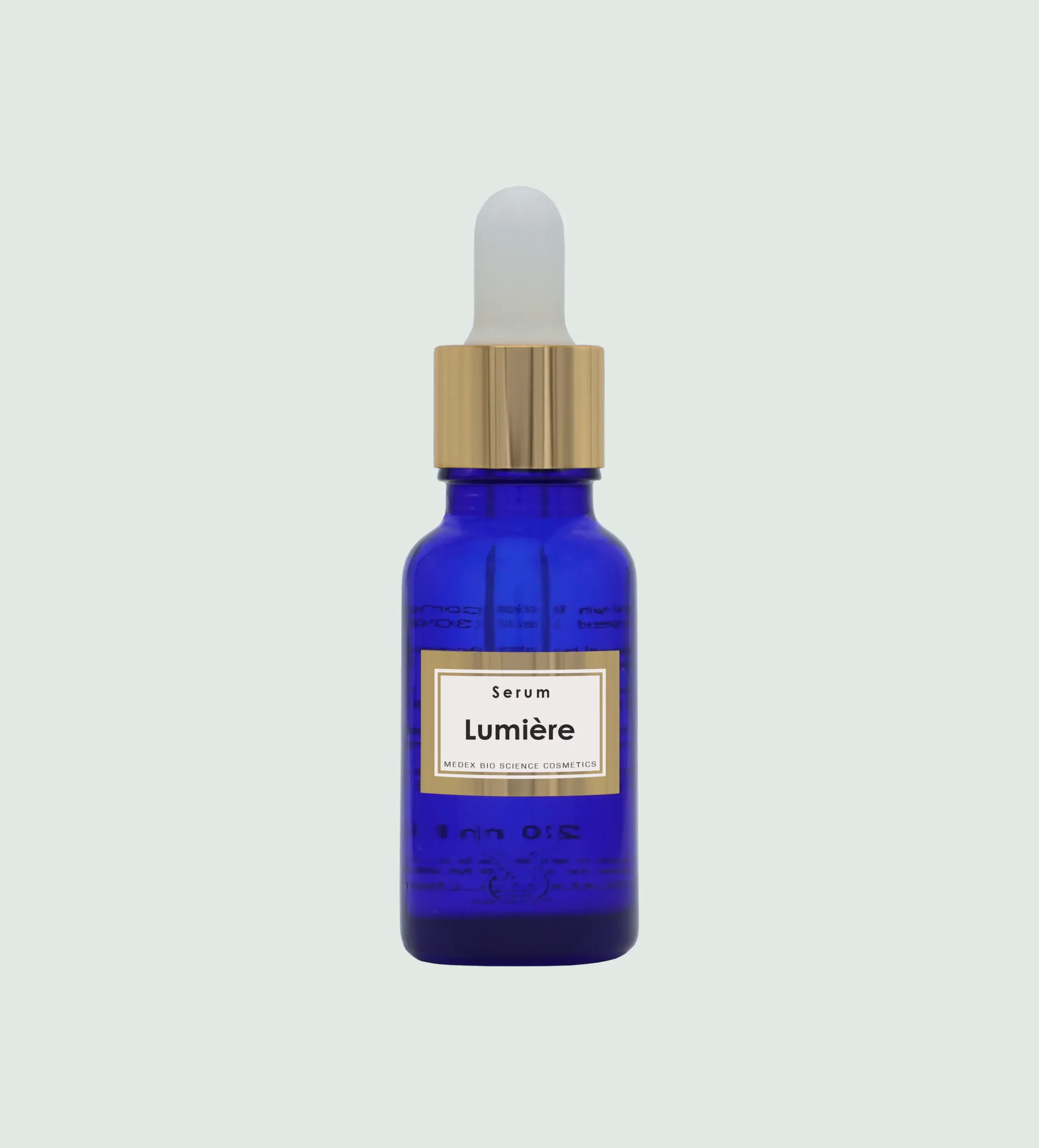
MEDEX product
Serum Lumière 20 ml
€ 45,40
The light serum
- Estimated Delivery: 
- Free Shipping: On all orders over 30,00 €
Secure Payment Systems :
The “light serum” Serum Lumière is to be used together with a Light Therapy Mask.
Serum Lumière creates an optimal skin barrier by providing a structured moisture balance, so the light can uniformly penetrate.
Suitable for skin improvement, blemished skin (acne-prone skin), dehydrated skin, hyperpigmentation and the treatment of minor scars.
You take a cure of appr. 2 months besides your daily skin care: Apply a few drops on your skin and leave to absorb for about 3 minutes, before applying your day or night cream. In this way you do the strongest possible before Mesotherapy or cosmetic surgery.
"Fagus Sylvatica-extract is obtained from young buds of the beech tree, in which a powerful mix of flavonoids, phytohormones and peptides is found, which form an enormous energy source all together. For human skin this extract has a very similar effect: it raises the energy level of the epidermal keratinocytes. In this manner the uptake of oxygen is stimulated and the biosynthesis of proteins, like filaggrin, is raised.
Filaggrin – epidermal protein
Filaggrin is a protein of the skin, which is less well-known than for example collagen and elastin, but just as important! Quite different from collagen and elastin, that are especially of interest for the dermis, filaggrin has its function in the epidermis. Filaggrin is the protein that initially aggregates all keratin filaments together in the keratinocytes. When the keratinocytes die off, the protein filaggrin gets a new function, since it will settle itself between the lipid layers, where it is a source of amino acids and oligo-peptides for the Natural Moisturing Factor (= the factor taking care of the skin’s natural moisturizing). This last remark is crucial, because the skin’s barrier is only able to function well, when it has the right moisture balance all the time, and filaggrin is taking care of that “naturally”. "
"Vegetable Glycerin
Glycerin is a small molecule that attracts water and binds it. These characteristics also make it a valuable ingredient for the Natural Moisturing Factor, which is responsible for the natural moisture balance in the skin.
At the end of the 18th century, long before the petrochemical industry was formed by mankind, the German Carl Wilhelm Scheele produced Glycerin for the first time in history by the saponification of olive oil. Although many changes were made ever since, the production process of gaining vegetable Glycerin from natural oil basically remained unchanged. Only the demands with respect to purity were optimized according to the latest pharmaceutical bench marks. In other words, this means that Medex created its products with pure, vegetable Glycerin."
"Hyaluronic Acid (INCI often SODIUM HYALURONATE) itself is a substance that is widely found in human connective tissue in the skin. This complex molecule takes care of the moisture balance because of its strong hydrating properties.
Hyaluronic acid is a body’s own polymer, frequently occurring in the skin as one of the so called “glycosaminoglycans”, also called “mucopolysaccharides”, the ground substance of connective tissue. The water binding capacity of hyaluronic acid plays a key role in connective tissue, since it determines its viscosity to a high extend. The carbohydrates from which hyaluronic acid is build are alternating N-Acetylglucosamine and D-Glucuronic acid, building a non-branched polymer together. Hyaluronic acid is a polyanion because of the carboxylate functional group of D-Glucuronic acid. Hyaluronic acid is also an important part of cartilage and estimates highly its elastic properties. Furthermore, hyaluronic acid partly determines the viscosity of synovial fluid in the joints, where it has a lubricating function, enabling the joints to move smoothly.
- Molecular Weight: because hyaluronic acid is a polymer, it has a wide range of different molecular weights from 5000 to 20 Million Dalton, which results in a range of mutually varying properties. Low molecular weight is called for example 1 Million Dalton, since the molecular weight of hyaluronic acid in the human body is 4 to 5 Million Dalton on average, while the molecular weight of hyaluronic acid in synovial fluid is 3 to 4 Million Dalton.
- Signal molecules: in the human body hyaluronic acid is broken down on purpose by enzymes, called Hyaluronidases. These breakdown products are usually oligosaccharides and sometimes function as a signal molecule for fibroblasts, that produce new collagen and elastin. When hyaluronic acid is broken down even more, e.g. in the liver, the final decomposition products are a.o. water and carbon dioxide.
- Application: in cosmetics / skin care as a powerful moisturizer upon/in the skin (the horny layer) and also in cosmetic medicine as a (sub)dermal “filler”, in which case usually a cross-linked version is used. A third application in favour of the skin is cosmetic mesotherapy, where the hyaluronic acid is transferred into the skin, 1 mm down at the dermal-epidermal junction, where it stimulates the fibroblasts’ synthesis, resulting in extra collagen and elastin for the skin. "